CITRINE
Imagine capturing the golden rays of the sun in a gemstone. You just imagined Citrine. It is a bright yellow variety of naturally occurring quartz. Citrine is a sister stone to the purple variety of quartz known as Amethyst, and in actuality, they are more than just sister gems; they are one in the same.
When quartz crystals form as a byproduct of the heating and cooling process associated with volcanic activity, any clear quartz that is forming in an iron-rich environment will turn purple and become Amethyst. These crystals form in two places; either in open cracks deep below the earth’s surface where lava has flowed, or they can form as hollow geodes as the molten rock is cooled when thrown into the air during a volcanic eruption. In either case, as the iron-based quartz is quickly cooled, the purple Amethyst gem is formed. This is the first step in creating a Citrine. In other words, all Citrine actually begin their lives as Amethysts. If any Amethyst deposit is slowly heated a second time by natural events, the color begins to slowly change to a bright yellow or gold.
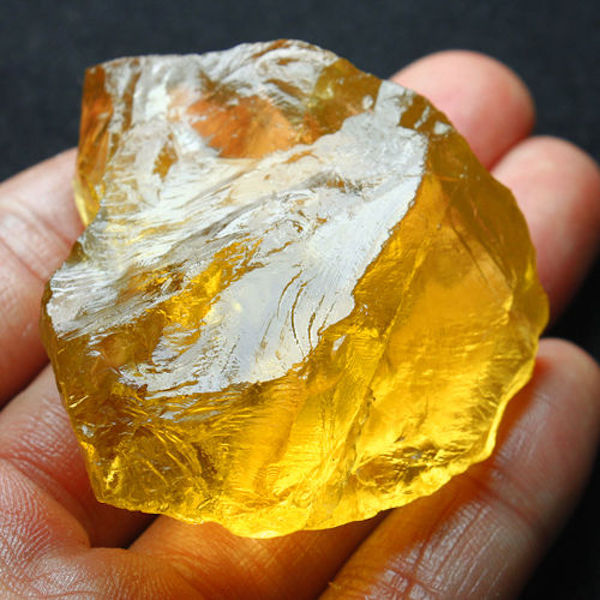
This slow natural heating process can happen a few different ways. If the Amethyst is formed deep enough below the surface, the high temperatures inside the earth can change the stones to yellow citrines. Another way this can occur is if surface-formed geodes are later exposed to a second lava flow where the purple gems trapped inside the hollow geode are slowly heated again, causing the color to shift to yellow. Because this second heating is an unusual natural occurrence, Citrine is much more difficult to find in nature than its more abundant counterpart Amethyst. However, a slow, low heating process is easily reproduced in a laboratory environment, so the conversion of Amethyst to Citrine is usually helped along by man. It is estimated around 70% of Citrine found on the market today is heated by man as opposed to finding it in natural occurrences and since this lab heating is identical to natural heating, there is no way of telling the difference between how the color change occurred.
Citrine comes in a wide array of yellow colors. It ranges from a light sunshine yellow to a dark golden tone with some stones having a more orangey yellow that can get to an almost burnt, dark orange. There are also citrines that can lean to a greenish yellow, and these stones can get to almost a chartreuse shade of yellow-green. There is no difference in the pricing between the different shades of yellow. The “perfect” color Citrine is found in the eye of the beholder.
There is another very interesting variation of natural Amethyst heating that occurs to create a gem that is half purple and half yellow within the same crystal. This gem is called an Ametrine. It gets its name from combining Amethyst and Citrine. Ametrine is only mined from a location in Bolivia and is formed naturally due to an uneven heating environment.
HISTORY AND FOLKLORE
Citrine was first named in 1556 when it was named after the French word “Citron,” which means lemon. Prior to that time, it was referred to as yellow quartz. The history and love for this gem date back to 300 B.C. when it was the stone of choice for the upper class in Ancient Greece. During that time, it was worn equally by men and women as well as often being used in objects of arts.
Later in the 17th Century, Scottish men commonly inset Citrines into the handles of their swords and daggers as it was believed the stone offered great strength and protection to its owner. Two hundred years later, it was the favorite of jewelry designers and Hollywood actresses during the Art Deco period.
Today the stone is often used as an alternative birthstone for Topaz as November’s birthstone. It is also highly prized for its larger sizes, versatile color, and affordability.
Citrine has long been associated with both the sun and citrus fruits. It is, therefore, no surprise that Citrine is considered an enlightening stone said to bring warmth and comfort to its wearer and also to help clarify cloudy thoughts and open intuitions – a sun-like metaphor. In keeping with its citrus associations, it is said to help with digestive issues while aiding both kidney and bladder functions. It is believed to raise self-esteem and confidence and wearing the gem helps eliminate any imbalances in the body and the soul.
WEARING AND CARING
Citrine, like other quartz varieties, has a hardness of 7 out of 10 on the Mors Hardness Scale. This makes it suitable for all jewelry uses. If a citrine is worn with proper care, it should be a friend for life to its wearer. Although it will hold up to most daily wear, it should be protected from situations where it can be hit or scratched. Citrine is susceptible to color changes if exposed to high heats and should not be exposed to dramatic temperature shifts. It can be lightly ultrasonic cleaned, but the owner should avoid steam cleaning.