MOONSTONE
Moonstone is a crystal form of feldspar, one of the most common elements on the face of the earth. When feldspar is super-heated due to volcanic activity and cools, it can crystallize in stacked layers of two types of feldspar: Orthoclase and Albite. The two crystals stack on top of each other to form the gem. The crystal is a milky white gem that is semitransparent. The stacked layers reflect light differently and create an appearance of billowy clouds of light blue and whites inside the stone. This optical effect is called adularescence. The overall color of the gem, along with the internal color play is reminiscent of moonbeams at night. That is how the gem got its name. It was believed that the reflection was a trapped moonbeam that was encapsulated in the gem. The degree of blue or white reflected color play depends on the size of the crystals of albite stacked within the stone.
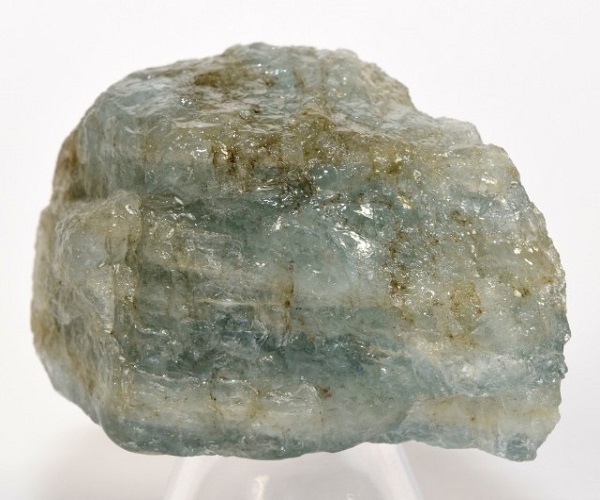
The blue cast is caused by very fine crystals of albite, the white sheen is caused by thick layers of albite. This color play is one way the gem can be found. Another of its varieties can show a cat’s eye effect. While most cat’s eye effects are caused by rutile inclusions within the gemstone, the cat’s eye effect in a moonstone is a matter of concentrating the internal reflection of the center of the cabochon gem. This concentrated reflection creates a bright center area down the center of the gem. The cat’s eye effect in a moonstone is much less defined than in other gems. The line is wider and looks more like a center glow than a hard line. There are two different effects that moonstone can display, the opalescence or the cat’s eye. In both cases the more transparent the gems, the more highly regarded. If the stone gets too cloudy or overall milky, the optical effects seem to get overshadowed. When looking for the cat’s eye effect, it all is a question of brightness and separating itself from the body color of the stone. The finest examples that show the color play or opalescence are the stones that have more blue and lavender flashes. Moonstones are mined in multiple locations, but the major producers are the United States, Sri Lanka (Ceylon), Austria, Norway, and Poland. The most known color of moonstone is the milky white body color. That is how it forms in nature in a pure form. However, if other elements enter the crystal as it is forming it can start to impact the body color. The colors may be beige, brown, greenish, or yellowish.
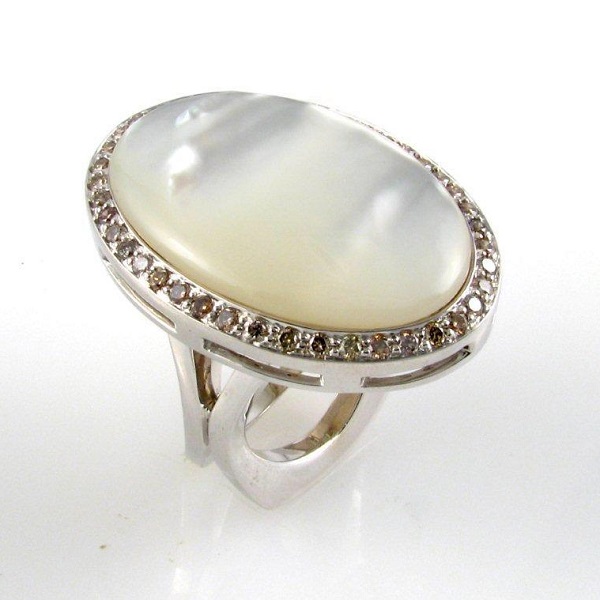
Occasionally the stones have impurities of iron oxide that change the stone to a reddish-orange. These stones are referred to as sunstone due to the resemblance to the sun. These reddish-orange varieties are the most expensive. The higher the rainbow color play in the white base gems or stronger the eye, the higher the price of the gem becomes. Moonstone is available in larger sizes and is a relatively modest priced gemstone.
HISTORY AND FOLKLORE
Moonstone has a history almost as old as the moon itself. The gem has always had a strong association with the moon. Ancient Greeks believed the stone was captured moonbeams that crashed on earth. The Romans used it as a sign of love given and worn in jewelry for over 2000 years. Moonstone jewelry has been found in the orient dating back 3500 years ago. The history in India is nearly as long. In India, today, the stone is often given on the wedding day as a gift of love. It represents the eternal love of the heavens and earth.
It has long been considered a protector of travelers, especially those that are traveling at night or on the open seas. It is also considered to have mystical powers that can channel prophecy and lead to a path of heavenly wisdom.
WEARING & CARING
Moonstone is a 6.5 in hardness out of 10 on the Moh’s hardness scale. This means the stone is an excellent choice for necklaces and earrings. It can be worn in rings if it is properly cared for. It should not be exposed to direct blows to the stone as it can chip.