PERIDOT
This ancient green gem, Peridot, is unique in the crystal world because it is one of the only gems that occurs in one singular color. While many other crystals can be found in multiple colors, like sapphire and tourmaline, Peridot crystals are always light green.
This olive or yellowish green colored crystal is actually named Olivine in the scientific world, but it has become known as Peridot in the jewelry world. Although the crystals are always light green, there can be many saturation and secondary tone variations to these gems. These slight differences in shades and tone are often an indication of their original geographical mining location. The stones can range from a very light yellowish green to a rather dark brownish green that mimics the color of an olive. The depth of color is based upon the amount of iron present when the crystal is first forming. The more iron present, the darker the gem with the most desired color tending to be right in the center of the spectrum. The darker saturated greens that show a secondary yellow, while avoiding the brown undertones are the most prized stones.
Another large factor in determining the value of Peridot is clarity. Many stones are plagued by a cloudy, milky effect that cuts down on the gems transparency.

The largest deposit of Peridot is located on the San Carlos Indian Reservation in central Arizona. This mine produces almost 55% of the entire world production of Peridot, and these “home-grown” stones are the most known of all of the Peridot. Unfortunately, these Arizona stones are impacted by two factors. First, they tend to exhibit a slightly milky effect. Second, they tend to be very small, almost always under 3 carats. These relatively abundant stones also tend to be the most affordable variety of Peridot for these same reasons.
It is difficult to find large Peridots from almost any known source because they typically grow in small grain-sized crystals that cling to their host rock. Stones that are found over 5-6 carats are very rare, and as size increases beyond that threshold, the stones become very collectible. When the size increases over 11-12 carats, the prices grow exponentially, and these stones usually end up in museums.
Peridot has been discovered in other locations, including China, Brazil, Egypt, Kenya, Myanmar, and most recently Pakistan. This newest discovery in Pakistan seems to produce a slightly larger stone that tends to have a secondary bluish undertone. Larger, high-quality stones from this source command a high premium. Other sources like China and Kenya are also finding stones between 6-10 carats that are also very collectible.
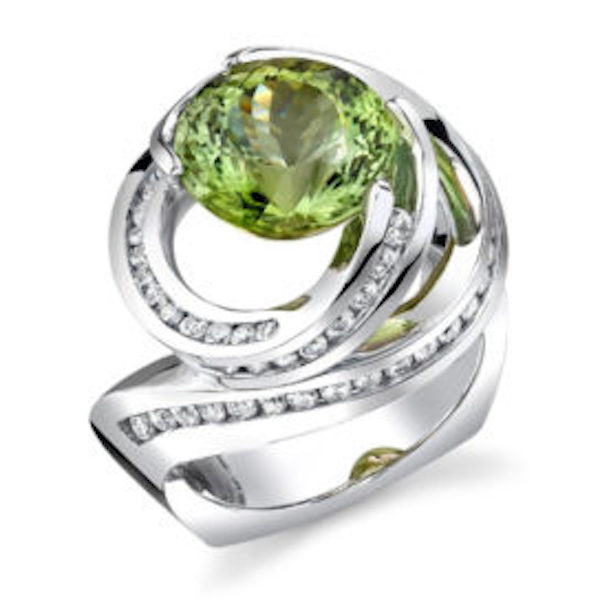
The most unusual source of Peridot comes from outer space where Peridot crystals are common formations found within a Pallasite Meteor. These Meteors are iron-based formations that formed at the time of the birth of the universe.
Peridot is often referred to as “The Night Stone” because of the crystal’s unique ability to gather even the faintest amount of light and then concentrate it and reflect it back to the wearer. It seems the less light available, the more the gem seems to glow.
HISTORY AND FOLKLORE
The history of Peridot dates back to 1500 B.C. during the time of the Pharaohs of Egypt. The first discovery of Peridot occurred on a tiny island in the Red Sea off the Egyptian coast called Zabargad Island. This island would be the only known source for this gem for the next 1000 years. After the initial discovery, the island’s inhabitants were used to mine the gems and taught to facet the stones for the Pharaoh and his family. These stones ended up in head dressed, scarabs, jewelry, and sculptures. The Pharaoh so valued these gems that the island was constantly surrounded by his army, and if anyone attempted to visit the island, or leave the island, they were put to death.
Island locals learned that the best way to mine the stones was to dig at night. They would wait until it was very dark and then light a single fire nearby causing the magical green stones to seemingly glow from their surrounding rocks making finding them very easy.
As more sources were discovered throughout the ages, the green gems became a favorite for both the royals and clergy. In the Dark Ages, the Knights Templar returned with Peridots from their crusades in the Middle East and used them to decorate church plates, chalices, and robes. One famously large Peridot was used to adorn the Shrine of the Three Holy Kings in the cathedral at Cologne, Germany. It is easy to imagine the fascination with these gems during a time when the only light at night was from either a candle or a fire.
The healing powers of Peridot are believed to be many, and it is said to attract lovers at night by strengthening your night vision (making it easier to find your lover in the dark). It was also believed that staring at a Peridot in the dark induces sound sleep and causes a calming effect on your thoughts and a purifying effect on your heart. The wearer will be cleansed of all emotional burdens and released from any guilt or obsessions. It was also prescribed as a cure for being afraid of the dark. That makes anyone born in August pretty lucky because this is their official birthstone.
WEARING AND CARING
Peridot is a 6.5-7 out of 10 on the Mohs Hardness Scale. This means it should be worn with care if it is set in a ring. Wearing it as you would wear a fine silk blouse is the best care advice for this stone. Peridot should not be exposed to dramatic temperature changes and should not be steam cleaned. The stone is more likely to scratch than to break, and facet abrasions can occur with aggressive wear. Peridot should not be exposed to commonly used Hydrochloric or Sulfuric acids, as they may etch the surface of the stone and require the need for it to be polished; therefore, Peridot must be fully masked off for an electroplating procedure.